Projects
Some background
When it comes to research projects, there are two main questions that are always in the back of my head. These would be: Why? and How? The site is organized in such a way, that here I try to answer the "Why part". So it has the form of a blog post, sort of, rather than more (or less) formal discussion that tries to answer the underlying "How". The description of particular projects that I am involved in, along with some results that have been obtained and (perhaps) links to the associated papers, can be found in the drop-down menu under the "Projects" category.
Anyway, if (for some reason that I cannot comprehend) you are interested in the informal (albeit superficial) story behind what I do, enjoy the discussion given below. Otherwise, it can be skipped altogether.
Outline of my research
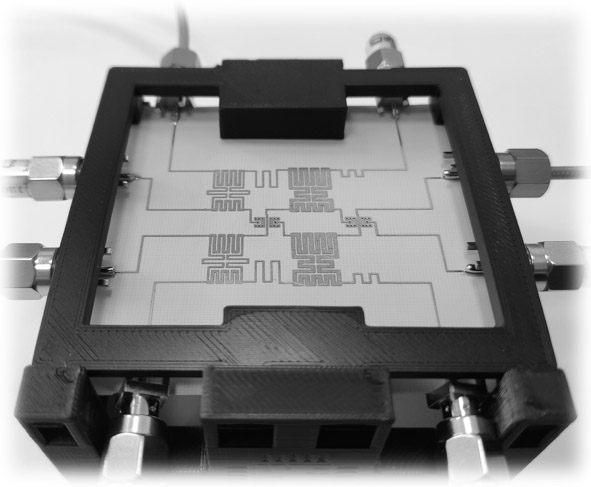
As it comes to the projects that spark my interest, there are a bunch of them. For most of my career, I was involved in development of passive microwave and antenna structures in one way or another. Examples include a Butler matrix shown in the figure on the right. Mostly, the research focused on rapid development of components in a regime that would nowadays be referred to as a data scarce modeling and optimization. The problem here is that, for complex components (here understood as anything that cannot be reliably modeled by quasi static analyses or based on analytical/empirical formulas) one needs to use electromagnetic (EM) solvers for performance evaluation. While technically this is a solved problem (at least since the middle of the 90s in the past century), the challenge is that EM simulations are computationally expensive. The fun part in all of that is that, computing power grows in a mind-blowing pace, but at the same time, the researchers come up with more and more complex topologies. At the end of the day, for at least the past two to three decades we are observing this tag game (sort of) where computing power tries to catch up with imagination of the researchers, whereas the latter ones try to squeeze as much juice of the resources as possible.
Automatic synthesis of antenna structures
One of my recent attempts to position my research somewhere along this race was to develop methods for automatic synthesis of antenna structures using surrogate assisted methods (yet hidden under more catchy phrases like machine learning and artificial intelligence - you know... because the term "statistical methods" is not fancy enough for the reviewers anymore). Anyway, these approaches are centered around a range of modeling and optimization methods in order to address (well... mitigate is a more appropriate term here) the problem associated with cognition-driven development of new components. In "human" language, this means that development of new antenna (or microwave component) topology is typically a trial-and-error procedure that involves implementation and EM-based validation of topology followed by a sequence of steps that can be summarized as introduction of changes and re-evaluation of modified design. Clearly, the process can be aided by numerical optimization techniques, but that does not make it less tedious. The prevailing (at least according to my point of view) human-centered approach to develop microwave components is something that pushed me into research on optimization-driven development of components in the first place.
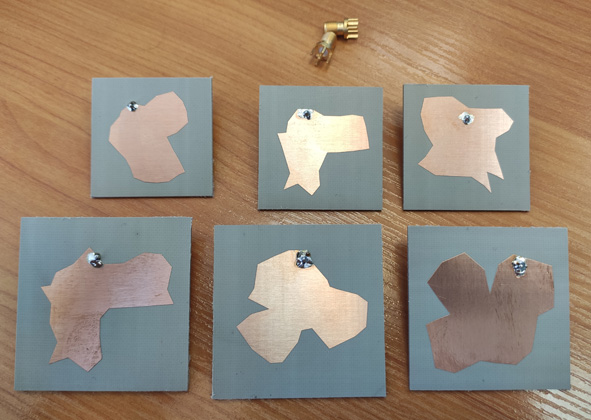
The project that I have above outlined is entitled: Efficient unsupervised synthesis and prototype-augmented modeling of radio-frequency structures
Some of the results that my team and I were able to obtain are associated with specification of antenna performance characteristics that might be of interest from the perspective of the designer (or end-user, whatever), followed by automatic generation of the topologies (the process includes appropriate representation of the structure topology, curation of the generated shape, automatic construction of the script that enables implementation and evaluation of its EM model, followed by assessment of the specified objective function). While the approach is more expensive (in computational terms) compared to optimization of pre-defined topology, it could bring some interesting results. The figure on the left demonstrates a set of microstrip patch antenna structures with asymmetric topologies that have been obtained based on the outlined routine. For more elaborate discussion on the topic (if you care), see drop down menu entry entitled Antenna synthesis...
Antenna measurements
Now it is time for the fun part (at least for me). Notice that the project title mentioned above contains the phrase "prototype-augmented modeling". As it turned out, this was the part that sparked the entirely new research adventure (at least for myself). The thing is that prototype-augmented modeling of structures is inherently uncertain due to a number of factors related to structure handling, measurement protocols, repetitiveness of the process and so on. While relatively manageable for simple microwave components (you can say, OK this coupler, when measured, does not align particularly well with simulation responses, but we can derive a mapping to accommodate for that), for experiments with antennas the discrepancies between the simulations and measurements could vary widely with frequency, structure type, test setup, and so on, and so on. To put more at the top of that, I did not have constant and uninterrupted access to appropriate measurement facilities back when the problem became difficult to neglect, so to say.
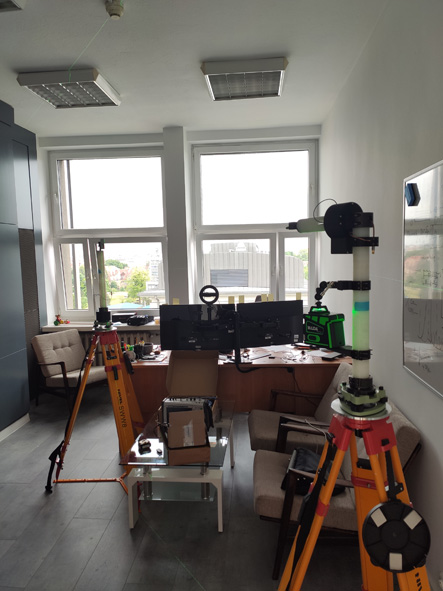
Long-story-short (I will provide a bit more background here), we developed a low-cost, portable system for accurate measurement of antenna far-field radiation patterns. On the mechanical level the platform is almost laughably simple, as it implements two geodesy tripods with tribrachs used as attachments to in-house developed rotary towers that enable rotation in boresight, azimuth and elevation planes (over a single plane). By the way, shout out to my master student who developed the rotary towers and their firmware.
The picture on the right illustrates the system, i.e., the towers with rotary heads deployed in my office for some routine experiments (yes, we can routinely perform reasonably accurate experiments in unfavorable propagation conditions as the ones shown in the picture). So the platform consists of typical components that can be found in any anechoic chamber including said positioning system, vector network analyzer (VNA), microwave cables, as well as software for positioning of antennas and data acquisition. On the hardware level, we neglected anything that could mitigate the effect of interferences or noise from external sources of EM radiation on measurement performance. This makes the system not only cheap, but also portable.
Clearly, measurements performed in uncontrolled conditions are useless for drawing meaningful conclusions on the prototype antenna performance if not for the appropriate post-processing algorithms. Of course, I found a bunch of them in the available literature (and struggled a lot with initial implementations). Of course, it quickly became apparent that the methods that we implemented are not generic enough to support our antennas and test sites out of the box. It also turned out that they can be challenging to tune with respect to the antenna at hand and test site of interest. I mean, it is manageable if one knows what parameters need to be changes and what are the reference responses to be matched to (preferably measurements obtained in anechoic chamber). However, any sane person would ask the following question: "why am I supposed to perform non-anechoic experiments if I already have measurements from a professional laboratory?"
The above is a valid question (I asked it as well :D), which began a quest towards the development of versatile algorithms for automatic correction of measurements performed in uncontrolled conditions. A journey that so far led us to publishing well over a dozen papers. If you care, more information on the topic should be available (someday) under the drop-down menu entry entitled Antenna measurements...
In-door positioning
The last but not the least concept that is lurking in the back of my head is related to in-door positioning systems. Specifically, I care about methods that exploit ultra-wideband (UWB) technologies and the likes (including their hybrids and various enhancements or modifications). Why? Well, my PhD dissertation was centered around low-cost (in terms of CPU-time) multi-objective optimization of antenna structures. While the topic was heavily related to numerical methods, most of the examples that my mentor and I were working on, were UWB radiators. In the middle of 2010s when I was (almost) completing my dissertation, I believed that UWB is, in fact, a dead technology with lack of practical applications. All the buzz words related to its use as a wireless USB standard, or super-high-speed data links, seemed to be a dead end.

In 2015, I learned about a new IC that is applicable for realization of "in-door GPS functionality". It was refreshing, I kinda felt that if PhD evaluation committee will ask me why UWB structures represent most of my examples, I would be able to provide at least one prospective example of technology use. Clearly, back then, I was not aware about the existence of companies (the names are specifically not included) that were already working on the technology. Much later did I learn that works on in-door localization span back to the late 90s of XX century. Anyway, I obtained my degree and forgot about the thing and lived my life.
A few years later, I was contacted by the hedge fund representatives, who asked me to perform analysis of the UWB-based localization technology developed by one of the companies they were interested in. That was great as it forced me to do a lot of research on a technology that did not represent the core of my research (I mean localization) and get creative on its prospective applications. All in all, I ended up with a few development kits obtained from competing vendors that are (clearly) not compatible with each other. Of course, such a move was intentional, as it makes things more interesting. While this project is in its infancy due to limited resources, I still find it fascinating. Again, some discussion on the underlying concepts is provided (or rather will be - some day) under the drop-down menu entry entitled Indoor localization...
A photograph on the left shows a test-bed of one of the systems that we recently activated with my master student. More info to come (later) :)